
Private Label Fragrance: Documents and Compliance for US Sellers
The product is only half of a private label perfume launch; the documents are the other half. For a US seller that means fragrance-material compliance, GMP evidence, testing results and label content all have to line up before the first carton ships. This checklist maps the documents a private label project should produce and what each one is actually for.
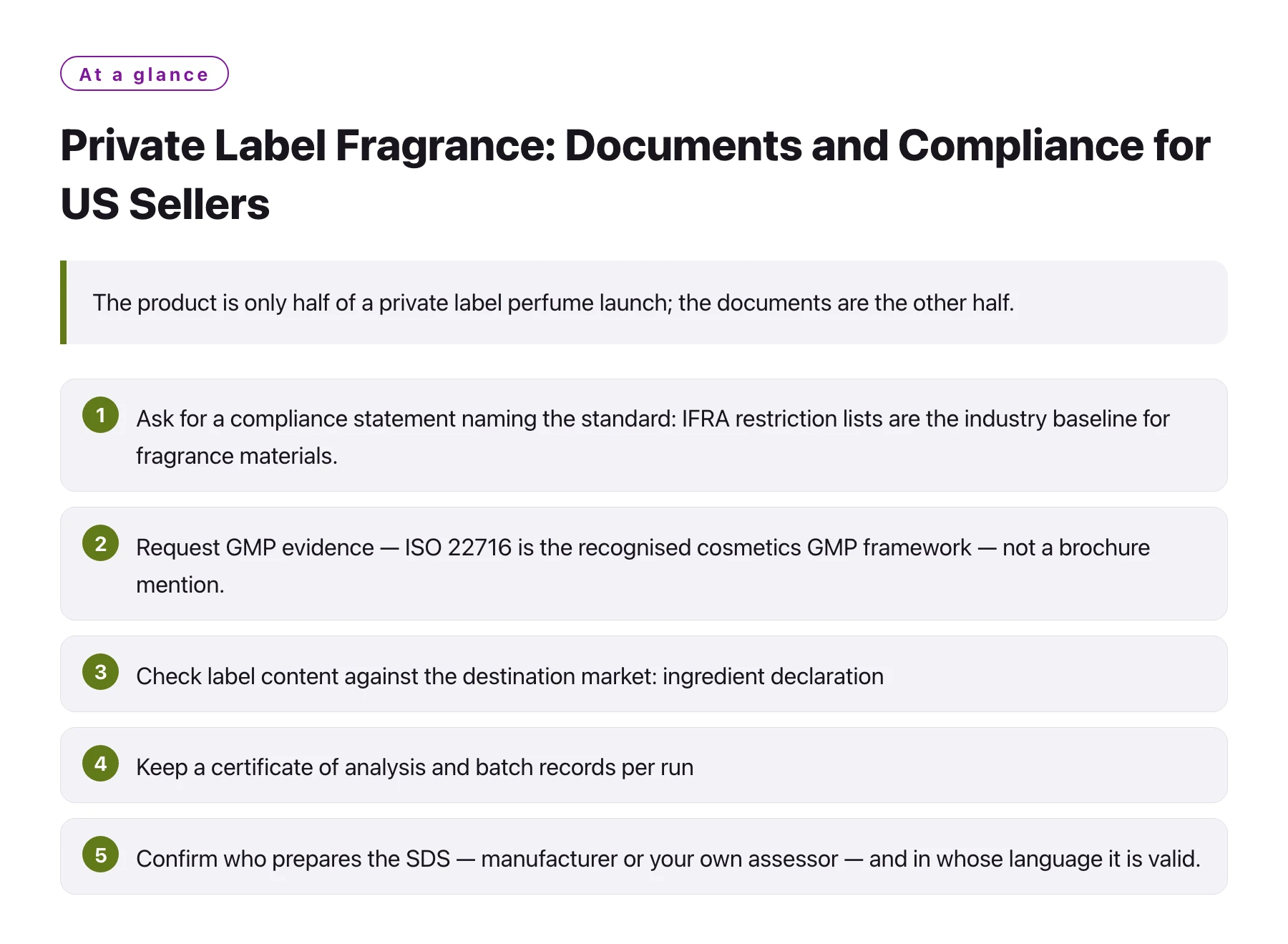
Key takeawaysAsk for a compliance statement naming the standard: IFRA restriction lists are the industry baseline for fragrance materials. · Request GMP evidence — ISO 22716 is the recognised cosmetics GMP framework — not a brochure mention. · Check label content against the destination market: ingredient declaration, net quantity and company identification are the baseline. · Keep a certificate of analysis and batch records per run; they unlock customs, retailers and reorders. · Confirm who prepares the SDS — manufacturer or your own assessor — and in whose language it is valid.
Why documents decide whether the launch ships
A private label project is attractive because the supplier does the manufacturing. But 'manufacturing' and 'compliance in your market' are different jobs: the factory's documents describe the product, and your documents describe the product to your market. The gap between them is where shipments stall — at customs, at retailer onboarding, at marketplace verification.
Working with a private label fragrance manufacturer means the supplier holds most of the technical data: the formula details behind the scent, the compounding records, the batch tests. The buyer's job is to demand, review and own the pack that the destination market will actually see.
The document pack, item by item
| Document | What it proves | Who holds it |
|---|---|---|
| IFRA compliance statement | The fragrance materials respect the industry safe-use restrictions | Usually the perfumer or the manufacturer |
| GMP certificate (ISO 22716) | The site operates a cosmetics GMP management system | The manufacturer; verify number, body and scope |
| Certificate of analysis | The batch meets its specification at release | The manufacturer, per batch |
| Stability report | The product survives its packaging over time | The manufacturer or a testing lab |
| Safety data sheet (SDS) | Hazard communication for transport and handling | Prepared by the manufacturer or your assessor |
| Label and artwork file | The label meets the destination market's content rules | Yours to review; the printer executes |
Each document answers a different question; a pack that cannot answer all of them is a pack with a hole in it.
Reading the pack like a compliance reviewer
The pack is only useful if someone reads it critically: the statement answers 'what is in the fragrance', the certificate answers 'was the site audited', the certificate of analysis answers 'was this batch correct', the stability report answers 'will it last', and the SDS answers 'how is it handled'. Buyers who read the pack as one story catch the gaps that shipping departments miss.
IFRA: the material baseline
Fragrance materials are managed through the restriction and safe-use standards published by the International Fragrance Association. The compliance statement should name the relevant standards explicitly, and because the library is public, a buyer can verify the claim rather than trust it [1].
GMP: the process baseline
ISO 22716 is the internationally recognised GMP framework for cosmetics — the standard a serious manufacturer works to — and third-party certification bodies audit against it [2]. Ask for the certificate number and scope; then verify with the issuer.
Ingredients: the transparency baseline
Even for markets outside the EU, the EU's public ingredient database (CosIng) is a useful reference for how ingredients are named and described when you need to compare claims across supplier packs [3].
When the whole pack comes from one roof
A supplier that produces under one roof — fragrance manufacturing under one roof — tends to generate the entire pack in one process, which is convenient. Convenience is not accuracy: the pack still has to be read against your market's rules, not against the supplier's standard pack.
Ask for the document pack in the language of the destination market, and have it reviewed before the production run begins. A pack fixed after production is a pack that delayed the launch.
Siding with reality: who signs what
For a US importer working with a Chinese producer, the arrangement is typically contract perfume manufacturing in China, and the document flow is a contract term: which documents the supplier prepares, which an assessor reviews, which you own, and in which language. Writing that list saves a customs hold later.
Ownership of the pack matters as much as its existence. If the formula file, the stability data and the label art belong to the supplier by default, your launch lives on borrowed documentation. Settle who holds what before the deposit, then keep the pack in a file you control.
Sources
- IFRA Standards Library (International Fragrance Association) —— The IFRA Standards Library lists the restrictions the fragrance industry applies to individual fragrance ingredients, based on safety assessments; it is the reference point for compliant fragrance formulation.
- SGS: Cosmetics, Personal Care & Household Testing —— Testing, inspection and certification services for cosmetics and personal care, including microbiological, stability and safety testing aligned with cosmetics GMP.
- EU CosIng — Cosmetic Ingredient Database (European Commission) —— The European Commission's CosIng database of cosmetic ingredients, listing ingredient functions, restrictions and labelling requirements under EU cosmetics law.
Frequently asked questions
Do I need a different document pack for every market?
The pack mostly overlaps, but each market has its own label content rules and its own accepted formats for safety information. A pack built for the US should be reviewed specifically for the US: ingredient declaration, net quantity and company identification are the baseline.
Who is responsible if the compliance pack is wrong?
Usually the brand that places the product on the market, which is why the review is the buyer's job even when the supplier prepares the documents. A supplier's standard pack is a starting point, not a substitute for a market-specific review.
What is the difference between a COA and a stability report?
A certificate of analysis documents that a specific batch met its specification at release — colour, odour, fill, appearance. A stability report documents that the product meets its specification over time and across temperatures, in its real packaging. Both are part of the pack.
Is an IFRA compliance statement the same as a safety assessment?
No. The IFRA statement says the fragrance materials respect the industry's safe-use restrictions; a full safety assessment considers the finished product, its packaging and its use. The statement is one input into the assessment, not a replacement for it.
Can I start shipping before the document pack is final?
Technically often yes; sensibly no. Customs, retailers and marketplaces ask for the pack at different points, and a hold at any one of them costs more than the few days the review takes. Treat the pack as a milestone, not an afterthought.
Read deeper. Skip the clutter. Join the Mania Club.
No pop-unders, no redirects — just the obsessively curated archive the 6.4M-strong community trusts. Newsletter is free, always will be.