
Issue No. 847 · Week of February 2026 · Hentai Mania
How does heat treatment improve a steel block’s strength?
Heat treatment processes reconstruct the internal crystal structure of steel blocks by precisely controlling solid-state phase transitions, thereby significantly enhancing their mechanical properties. Take the most common quenching process as an example. When a medium carbon steel block with a carbon content of 0.4% is heated to the austenitizing temperature of 850 degrees Celsius and held for 60 minutes before rapid water quenching, its internal structure will transform from soft ferrite and pearlite to high-hardness martensite. This phase transformation can cause the Rockwell hardness of the steel block to soar from the original HRC 15 to over HRC 55, and the tensile strength to jump from 500 megapascals to 1500 megapascals, with an increase of up to 200%. The 2023 research report of the German Materials Association indicates that by using a laser scanning temperature measurement system to control the furnace temperature fluctuation within ±3 degrees Celsius, the standard deviation of the hardness of the steel block after heat treatment can be reduced from HRC 5 in the traditional process to HRC 1.2.
Tempering treatment is a key stage in optimizing toughness and stress distribution. Reheating the quenched steel block to the range of 300 to 600 degrees Celsius and holding it for 2 to 4 hours can cause the unstable martensite to partially decompose into tempered sorbite. Data shows that the impact toughness of 42CrMo4 alloy steel blocks tempered at 450 degrees Celsius can reach 80 joules, which is three times that of the quenched state, while maintaining a service hardness of HRC 38-42. The multi-stage tempering technology applied by NASA in the manufacturing of the Mars probe arm first keeps the steel block at 350 degrees Celsius for 120 minutes, and then gradually cools it down to 200 degrees Celsius for 180 minutes. This increases the fracture toughness of the component in the extreme environment of -120 degrees Celsius by 25% and reduces the defect propagation rate by 40%.
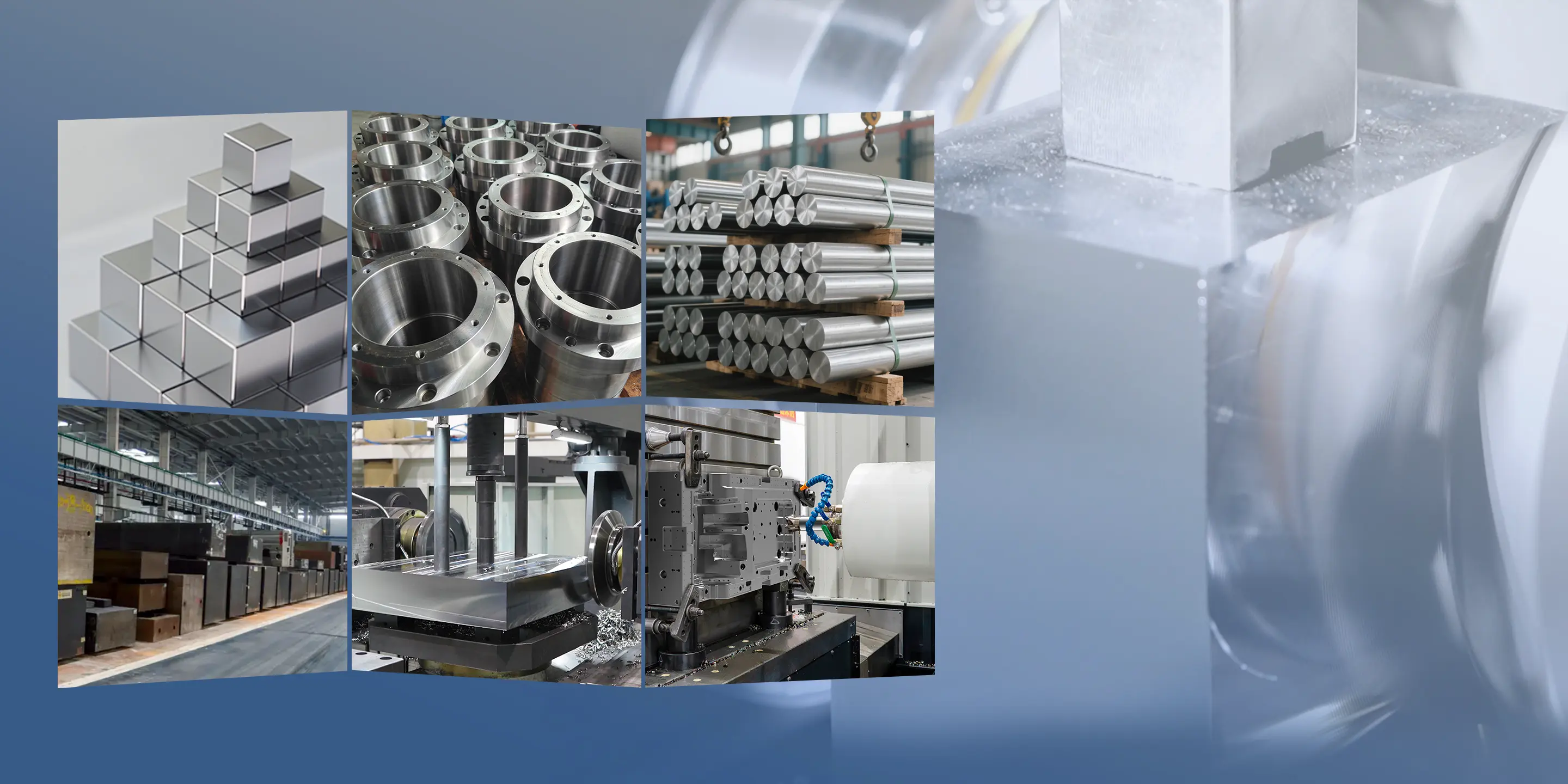 Chemical heat treatment can endow the surface of steel blocks with special properties. Nitriding treatment is carried out in an ammonia atmosphere at 500-520 degrees Celsius for 20-48 hours, which can form a compound layer 0.2-0.8 millimeters thick on the surface of the steel block. The surface hardness can reach HV 1000-1200, which is 150% higher than the hardness of the base material. The manufacturing data of Volkswagen's transmission gears shows that the contact fatigue life of steel block parts treated with controlled atmosphere nitriding has been increased from 500,000 cycles to 2 million cycles, and the wear rate has been reduced to one fifth of that of untreated parts. Carburizing treatment increases the carbon concentration from 0.2% to 0.8% at 920 degrees Celsius. After quenching, the surface hardness reaches HRC 60-64, while the core still maintains a toughness of HRC 30-40. This gradient structure extends the rated service life of wind power bearings to over 100,000 hours.
From an economic benefit perspective, optimizing the heat treatment plan can bring significant full-cycle benefits. Using induction heating instead of box furnaces to process steel blocks with a diameter of 200 millimeters can compress the heating time from 180 minutes to 45 seconds, reduce energy consumption by 35%, and lower the oxide scale loss rate from 3% to 0.5%. After Sany Heavy Industry reengineered the heat treatment process of the hydraulic pump body, it saved 18 yuan per piece in cost and increased the annual efficiency of the production line with an annual output of 200,000 sets by 3.6 million yuan. More importantly, precise heat treatment has reduced the failure probability of steel block products from five in ten thousand to ten in a million. According to the European Mechanical Failure Database, this is equivalent to avoiding potential recall losses of approximately 120,000 US dollars per ton of heavy equipment.
Chemical heat treatment can endow the surface of steel blocks with special properties. Nitriding treatment is carried out in an ammonia atmosphere at 500-520 degrees Celsius for 20-48 hours, which can form a compound layer 0.2-0.8 millimeters thick on the surface of the steel block. The surface hardness can reach HV 1000-1200, which is 150% higher than the hardness of the base material. The manufacturing data of Volkswagen's transmission gears shows that the contact fatigue life of steel block parts treated with controlled atmosphere nitriding has been increased from 500,000 cycles to 2 million cycles, and the wear rate has been reduced to one fifth of that of untreated parts. Carburizing treatment increases the carbon concentration from 0.2% to 0.8% at 920 degrees Celsius. After quenching, the surface hardness reaches HRC 60-64, while the core still maintains a toughness of HRC 30-40. This gradient structure extends the rated service life of wind power bearings to over 100,000 hours.
From an economic benefit perspective, optimizing the heat treatment plan can bring significant full-cycle benefits. Using induction heating instead of box furnaces to process steel blocks with a diameter of 200 millimeters can compress the heating time from 180 minutes to 45 seconds, reduce energy consumption by 35%, and lower the oxide scale loss rate from 3% to 0.5%. After Sany Heavy Industry reengineered the heat treatment process of the hydraulic pump body, it saved 18 yuan per piece in cost and increased the annual efficiency of the production line with an annual output of 200,000 sets by 3.6 million yuan. More importantly, precise heat treatment has reduced the failure probability of steel block products from five in ten thousand to ten in a million. According to the European Mechanical Failure Database, this is equivalent to avoiding potential recall losses of approximately 120,000 US dollars per ton of heavy equipment.
Chemical heat treatment can endow the surface of steel blocks with special properties. Nitriding treatment is carried out in an ammonia atmosphere at 500-520 degrees Celsius for 20-48 hours, which can form a compound layer 0.2-0.8 millimeters thick on the surface of the steel block. The surface hardness can reach HV 1000-1200, which is 150% higher than the hardness of the base material. The manufacturing data of Volkswagen's transmission gears shows that the contact fatigue life of steel block parts treated with controlled atmosphere nitriding has been increased from 500,000 cycles to 2 million cycles, and the wear rate has been reduced to one fifth of that of untreated parts. Carburizing treatment increases the carbon concentration from 0.2% to 0.8% at 920 degrees Celsius. After quenching, the surface hardness reaches HRC 60-64, while the core still maintains a toughness of HRC 30-40. This gradient structure extends the rated service life of wind power bearings to over 100,000 hours.
From an economic benefit perspective, optimizing the heat treatment plan can bring significant full-cycle benefits. Using induction heating instead of box furnaces to process steel blocks with a diameter of 200 millimeters can compress the heating time from 180 minutes to 45 seconds, reduce energy consumption by 35%, and lower the oxide scale loss rate from 3% to 0.5%. After Sany Heavy Industry reengineered the heat treatment process of the hydraulic pump body, it saved 18 yuan per piece in cost and increased the annual efficiency of the production line with an annual output of 200,000 sets by 3.6 million yuan. More importantly, precise heat treatment has reduced the failure probability of steel block products from five in ten thousand to ten in a million. According to the European Mechanical Failure Database, this is equivalent to avoiding potential recall losses of approximately 120,000 US dollars per ton of heavy equipment.
Read deeper. Skip the clutter. Join the Mania Club.
No pop-unders, no redirects — just the obsessively curated archive the 6.4M-strong community trusts. Newsletter is free, always will be.