
Birch Panels for Joinery: Machining, Turning and Pre-Drilling
Birch is a hard, dense hardwood, and the published notes are unusually practical because of it: the panel machines well, hand tools tire you out, and pre-drilling is advised. The species named on the page is Betula Alleghaniensis, sourced from Canada and the eastern United States, and it is offered in 12 mm, 18 mm and 24 mm thicknesses in a 4 × 8 format. For a joinery shop, the density that makes it hard work by hand is the same density that makes it strong in service.

Key takeaways
- The species is named as Betula Alleghaniensis, also sold as American birch, Quebec birch, hard birch, silver birch or swamp birch.
- Timber origin is published as Canada and the eastern United States, where the species grows in commercial volumes.
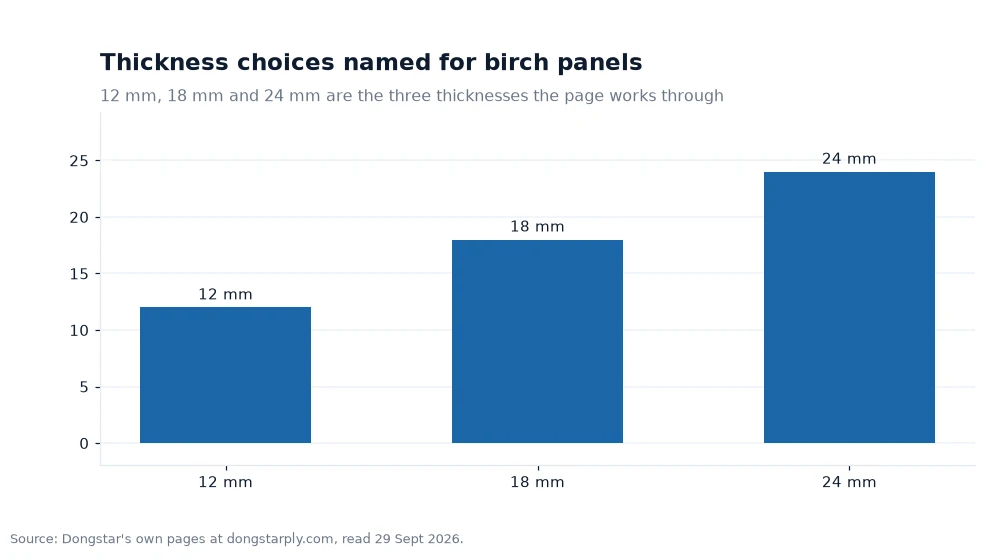
- Three published steps define the range: 12 mm where joinery detail matters, 18 mm for cabinets and floors, and 24 mm once the duty turns heavy or marine.
- The panel is dense and hard, so pre-drilling is recommended before screws go in, and hand tools will feel the effort on long runs.
What the species name settles before you cut
Trade names travel loosely, so the botanical name on the Birch Plywood datasheet is worth pinning down early. The page identifies the timber as Betula Alleghaniensis and lists the aliases it appears under — American birch, Quebec birch, hard birch, silver birch and swamp birch. Buyers who order simply "birch" may receive a lighter, softer species that carries the same word on the invoice and behaves differently under a cutter.
Origin is stated just as plainly: Canada and the eastern United States. That matters to anyone assembling documentation for a project, because provenance questions are usually answered from the supplier's own specification rather than from a general claim about northern hardwoods.
Density, hand tools and the pre-drilling advice
The published note says the wood machines well but is dense enough that hand tools become tiring work. That is a scheduling point as much as a tooling one. A bench hand happily cutting softwood all morning will feel the difference on a birch run by mid-afternoon, and a shop planning output should account for it rather than discover it.
Pre-drilling is the other fixture of the published advice, and it follows directly from the density. A screw driven straight into a hard, stiff panel builds up stress around the shank, and that stress is what opens a split near an edge or a hole that sits close to a corner. Drilling a pilot first relieves most of it, which is why the advice appears alongside the machining notes rather than buried in a general section.
Turning work and the shapes birch is known for
Birch turns well — the page lists that property explicitly — and it names the turned goods made from it: spools, bobbins, shuttles, dowels and bowls. A timber that holds a shape on a lathe needs consistent density and straight, even grain, because any soft patch shows up as a flat spot in the finished profile.
Beyond turning, the published uses widen to boxes, baskets, woodenware and cooperage. Those are all products where a component is handled constantly and takes knocks in use, and where the wood's weight and stiffness matter more than its figure. None of them rely on birch looking decorative; they rely on it staying true.
Grain, colour and how the sheet takes a finish
The published description of the wood is straight-grained with a fine, even texture. Colours are split between a reddish-brown heartwood and a pale yellow sapwood, which is the reason a clear-finished birch panel can show two tones across a wide face unless the boards are sorted before assembly.
It is also described as heavy, hard, strong and stiff — four words that together explain its reputation in load-bearing and long-span furniture components. For painted work, the even texture means a finish sits flat without the open grain that some harder species show, and for clear work it means the grain reads as quiet rather than busy.
Choosing between the three thicknesses
The range is anchored by 12 mm for fine joinery, 18 mm for flooring, cabinets and structural work, and 24 mm for heavy, marine and industrial applications. Those three steps correspond to three different jobs rather than three price points, and mixing them within one assembly is normal: a 24 mm component can carry a 12 mm panel without either thickness being wrong.
The common imperial equivalents are published too, and they are the numbers most North American drawings still use: 1/2 inch is about 12.7 mm and 3/4 inch about 19.05 mm. A shop working from imperial plans can therefore match a metric sheet to the drawing without guessing, which removes a source of error that only shows up at assembly.
| Published point | Value | Effect in the workshop |
|---|---|---|
| Species | Betula Alleghaniensis | Dense, hard stock that holds detail under a cutter |
| Origin | Canada and the eastern United States | Answers provenance questions from the datasheet |
| Machining | Machines well; hand tools are tiring | Budget more bench time than for softer species |
| Fixing | Pre-drilling recommended | Reduces splitting near edges and corner fixings |
| Thickness | 12 mm, 18 mm, 24 mm in 4 × 8 format | Fine joinery, cabinets and floors, heavy and marine work |
Worked example: components per panel at three thicknesses
Say a component measures 400 mm × 300 mm. That is 0.4 × 0.3 = 0.12 m² each (example arithmetic). One 1220 × 2440 mm sheet measures 1.22 × 2.44 = 2.9768 m², which divides into 2.9768 ÷ 0.12 = 24.8 components — 24 usable parts once a saw kerf and edge trim are allowed for (example). Forty of those components need 40 × 0.12 = 4.8 m², or two sheets with the offcuts kept for small turned parts.
Thickness then changes the cube rather than the count. At 24 mm a sheet measures 2.9768 × 0.024 = 0.0714 m³; at 12 mm the same sheet measures 2.9768 × 0.012 = 0.0357 m³ (example). The 24 mm sheet occupies exactly twice the volume of the 12 mm sheet for the same surface area, which is the number to have ready when a customer asks why the heavy-work option costs more to move as well as to buy.
Frequently asked questions
Why is pre-drilling recommended for this panel?
Because the wood is dense, hard and stiff. A screw driven straight in builds up stress around the shank, and that stress can open a split near an edge or a fixing close to a corner, so a pilot hole is drilled first.
Which thickness suits cabinet and floor work?
The 18 mm step is the one published for flooring, cabinets and structural components. The 12 mm panel is intended for fine joinery, and the 24 mm sheet for heavy-duty, marine and industrial applications.
What does 3/4 inch equal in metric birch panels?
Three-quarters of an inch is about 19.05 mm, and half an inch is about 12.7 mm. Those equivalents are published alongside the metric thicknesses so imperial drawings can be matched to the metric sheets on offer.
Checking the panel against the rest of the range
Hardwood species choice sits inside a wider specification, and shops that use several panel families can compare the options on the full product line before settling on a species and thickness. The company background behind the mill is worth a read as well when a project asks where the timber and the entity behind the contract actually sit.
Species data, thicknesses and machining notes above come out of the supplier's website, read on 29 September 2026, as the source for this comparison, and taken for this write-up[1].